
Few household issues are as immediately alarming and thoroughly unpleasant as walking into your home and being hit by a pungent, foul stench of sewage. When a rotten egg or waste odour invades your living space, it is more than just a threat to your comfort—it is a clear warning sign that dangerous sewer gases, such as hydrogen sulfide, are bypassing your plumbing system and leaking into the air you breathe.
Because of Blackpool’s unique coastal geography, high density of older Victorian and Edwardian terrace properties (particularly in Central Blackpool, South Shore, and Layton), and a massive seasonal hospitality/rental market, indoor drainage odours are incredibly common here. If you are trying to figure out what causes a sewer smell in a house, here is an expert breakdown of the most frequent structural and plumbing failures found across the Fylde Coast.
How Sewer Gas Breaches Your Home: The Basics
Under normal circumstances, your household plumbing is brilliantly engineered to keep sewer gases exactly where they belong—underground. Every sink, toilet, shower, and washing machine line features a “water trap” (commonly a U-bend or P-trap). This curved section of pipe holds a small, permanent reservoir of water that acts as a physical seal, blocking gases from traveling up from the main sewer into your rooms.
When you smell sewage indoors, it means that protective water barrier has either failed, dried out, or been pulled away by a structural pressure issue.
The Top 4 Causes of Sewer Smells in Blackpool Properties
1. Dried-Out U-Bends (The Holiday Let & Guest Room Syndrome)
This is arguably the single most common cause of sewer smells in Blackpool. Because our town relies heavily on seasonal tourism, guest houses, holiday lets, and flats frequently sit empty during the late autumn and winter months.
When a bathroom shower, bath, or basin goes unused for several weeks, the stagnant water sitting in the U-bend simply evaporates into the air. With the physical barrier gone, an open pathway is created, allowing sewer gas from the street mains to vent straight up into the building. Fortunately, the fix for this is simple: run your taps and flush all toilets for a few minutes to re-establish the water seal.
2. Blocked Soil Vent Pipes (SVP) and Failed Durgo Valves
If you notice a foul smell that gets significantly worse every time a toilet is flushed, or if you hear a strange gurgling sound coming from your kitchen sink when the washing machine drains, your system has a venting issue.
Your property features a vertical pipe—the soil vent pipe—that runs up through the roof to release sewer gases safely into the atmosphere. On the Fylde Coast, high winds frequently drive loose roof moss, twigs, or even nesting birds into open roof vents. Alternatively, modern internal air admittance valves (known as Durgo valves) can seize up over time. When these vents clog, flushing a toilet creates a powerful internal vacuum that aggressively sucks the water right out of your surrounding sink and shower traps, leaving them wide open to foul odours.
3. Cracked or Misaligned Underground Clay Pipes
If you live in a traditional brick terraced home near Blackpool town centre, your drainage system likely relies on original subterranean vitrified clay pipes. Over decades, natural ground movement, heavy traffic vibration, and tree root ingress can cause these rigid pipes to fracture, split, or drop at the joints.
When a pipe breaks beneath your floorboards or right outside your damp-proof course, wastewater and raw sewage seep continuously into the subsoil. The resulting sewer gas rises up through cracks in the concrete foundations, behind plasterboard walls, or under laminate flooring, creating an elusive, persistent stench that bleach cannot fix.
4. Main Sewer Surcharging and Coastal Backflow
Low-lying areas of Blackpool occasionally suffer from drainage backflow during periods of severe coastal storms combined with torrential rain. When United Utilities’ main public storm sewers under the road become overwhelmed with water, the pressure can force stagnant sewer water and gas backward up your private lateral lines, surcharging through your lowest ground-floor gullies, shower trays, or toilets.
| The Symptom indoors | The Common Structural Cause | Specific Blackpool Risk Factor |
|---|---|---|
| Smell comes and goes in seasonal properties | Evaporated water traps / dry U-bends | Unoccupied winter holiday rentals and seasonal B&Bs. |
| Sinks gurgle loudly when water drains elsewhere | Blocked roof vent stack or failed Durgo valve | Coastal wind debris or nesting birds blocking open roof terminations. |
| Persistent smell beneath floorboards or stairs | Fractured or displaced subterranean clay pipes | Aged structural infrastructure in Victorian and Edwardian builds. |
How a Blackpool Specialist Pinpoints the Exact Odour Source
Because sewer gas is invisible, trying to guess which pipe or joint is leaking behind a finished wall cavity or under a floor can result in a lot of wasted time and unnecessary damage to your decor.
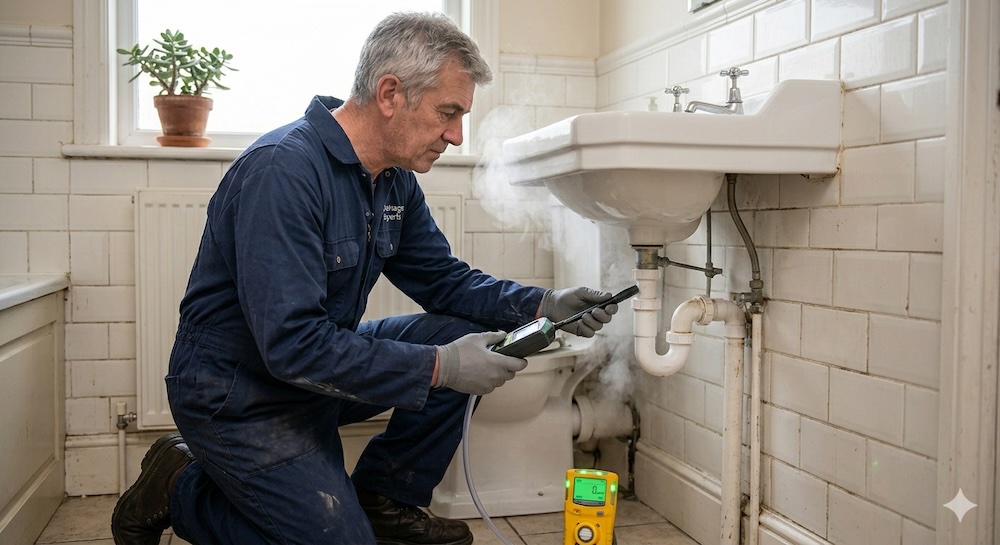
Professional engineers use advanced **Mechanical Smoke Testing** to solve this problem without guesswork. We temporarily seal your drainage network and pump a dense, non-toxic, highly visible diagnostic smoke down into the system under light pressure. Within seconds, the smoke will plume out of the exact microscopic fracture, loose joint connection, or failed valve, revealing the precise location of the gas leak so it can be repaired cleanly.
Eradicate Dangerous Sewer Odours Permanently
Don’t sit there breathing in toxic sewer gases or trying to mask the issue with chemicals. Our local, independent Blackpool team provides comprehensive smoke diagnostics, CCTV asset mapping, and fixed-price drain unblocking across the entire Fylde Coast.
Call Our Blackpool Base: 07739 961430
Office Location: 99 Breck Road, Poulton-le-Fylde, FY6 7AN
Book a Diagnostic Test: Arrange an Expert Odour Investigation