
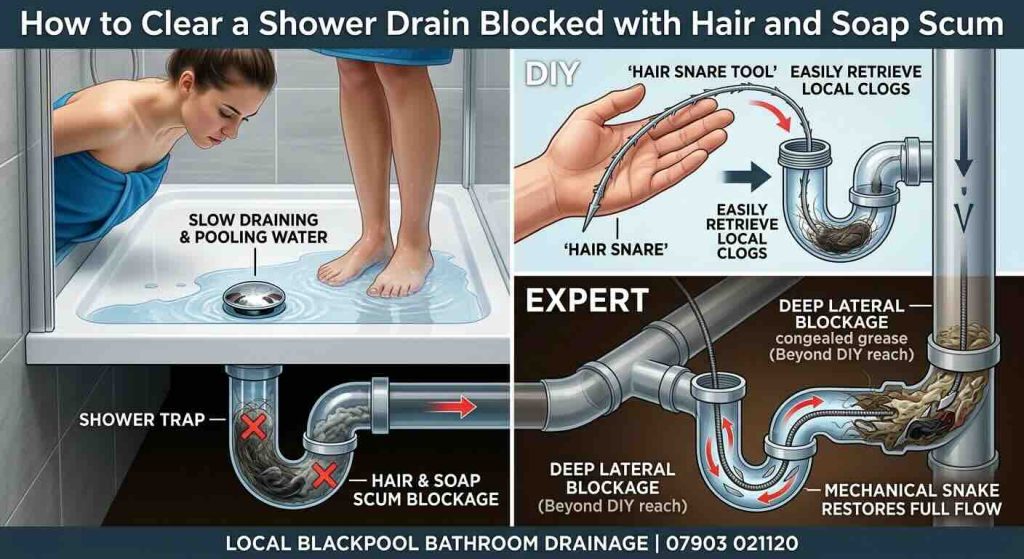
Standing in a pool of lukewarm, soapy water while taking your morning shower is a clear sign your bathroom drainage has ground to a halt. A slow-draining shower basin is one of the most common domestic plumbing frustrations. Over months of daily use, long strands of hair naturally bind together with body fats, visual residues, and congealed shower gels to create an incredibly tough, glue-like obstruction inside the pipeline.
While this issue starts as a minor everyday annoyance, letting a shower clog fester can cause dynamic structural issues deeper in your waste lines. Knowing precisely how to clean hair out of shower drain setups without damaging your underlying plastic traps is the fastest way to restore a free-flowing system.
The Anatomy of a Shower Trap Clog
Unlike kitchen sinks that have deep, easily accessible P-traps beneath a cupboard, modern shower enclosures use low-profile, shallow traps tucked directly under the tray. These compact traps are designed to save floor space, but their tight internal bends make them highly prone to anchoring hair. When hair wraps around the internal cylinder, it creates a physical net that rapidly catches passing soap scum, completely closing off the flow pipe.
The Dangerous Mystery: Shower Trap Not Holding Water
While most homeowners focus purely on a blockage that causes water to back up, a hair clog can create the exact opposite problem. If you notice an influx of foul sewer smells in your bathroom and discover your shower trap not holding water, a thick mass of hair is often the culprit.
When long hair strands become densely packed inside the trap, they can extend over the internal weir of the U-bend and down into the waste pipe. This creates a literal capillary wick. The hair pulls the standing water reservoir over the lip and drains it away into the main branch line. Without that vital water seal holding its ground, raw sewer gas has an open path straight into your bathroom. Cleaning out the hair mass immediately resets the capillary action and allows the trap to maintain its protective water barrier.
Step-by-Step Guide to Removing Hair and Soap Scum
Before you spend money on professional equipment, you can attempt to clear standard, localized hair clogs using safe mechanical methods:
- Step 1: Remove the Cover Plate or Grate – Most modern shower wastes feature a chrome dome cover that lifts straight off or unscrews anti-clockwise. Remove it to reveal the internal plastic trap insert.
- Step 2: Extract the Internal Dip Tube – Many modern low-profile shower wastes have a central removable cylinder (dip tube). Pull this out vertically and wipe away the thick layer of soap scum and matted hair coating it.
- Step 3: Deploy a Plastic Hair-Snare Tool – Insert a flexible, barbed plastic drain cleaning tool (often called a ‘drain snake stick’) down into the waste pipe. Twist the tool around and pull it back out smoothly. The barbs will catch and retrieve the main body of the matted hair mass.
- Step 4: Flush with Hot Water – Boil a kettle, let it cool slightly so it isn’t completely boiling (to protect thin plastic pipes), and pour it down the open line to melt away residual grease and soap fats.
When DIY Tips Fail: The Deeper Lateral Blockage
If you have successfully pulled out a handful of hair, cleaned the internal trap inserts, and flushed the line, but the water in your shower basin still rises rapidly, the restriction does not sit in the shower tray assembly. The problem is positioned further down the shared lateral line or inside the main bathroom soil stack.
When hair passes through the immediate trap, it can lodge against internal pipe joints or structural sags beneath the floorboards. Plungers and retail chemical flushes are completely ineffective at this depth. Resolving a deep lateral restriction requires a professional mechanical cleaning snake or a high-pressure water jetting system to cleanly cut through the structural grease and hair accumulation without risking a sub-floor pipe rupture.
Is Your Shower Completely Blocked? We Have the Solution.
If your shower tray is pooling water or a persistent bad smell suggests your trap isn’t holding its water seal, don’t risk damaging your bathroom with corrosive chemicals or aggressive plunging. At Drainage Experts, we resolve deep domestic blockages across Blackpool and the wider Fylde area using professional mechanical plumbing snakes and specialized diagnostic gear.
We provide clear, fixed pricing on standard domestic clearances. Our specialist engineering team will safely clear out your stubborn hair and soap scum blockages, fully executing a professional drain unblocking in Blackpool to restore immediate, free-flowing drainage to your bathroom fixtures.
Speak Directly to a Local Drainage Engineer: 07903 021120
Our Regional Operations Base: 99 Breck Road, Poulton-le-Fylde, FY6 7AN
Book an Emergency Shower Clearance: Arrange a Professional Drain Inspection