
How to Stop Tree Roots Growing in Drains (The Definitive Fylde Coast Guide)
Few property issues are as quietly destructive as subterranean root intrusion. For homeowners across Blackpool, Lytham St Annes, and Poulton-le-Fylde, recurring drainage issues are rarely just down to excess toilet tissue or cooking grease. More often than not, the true culprit is a complex, living root network that has quietly hollowed out your underground pipework.
Traditional vitrified clay pipelines are structural staples across older Fylde Coast properties. Over decades, subtle ground movement shifts these pipe sections, creating hairline fractures. To a nearby tree or hedge, that microscopic fracture is an open invitation. If you are experiencing unexplained plumbing issues, understanding the mechanics of root growth is the first step toward safeguarding your home infrastructure.
The Biological Mechanics: How Roots Invade Pipes
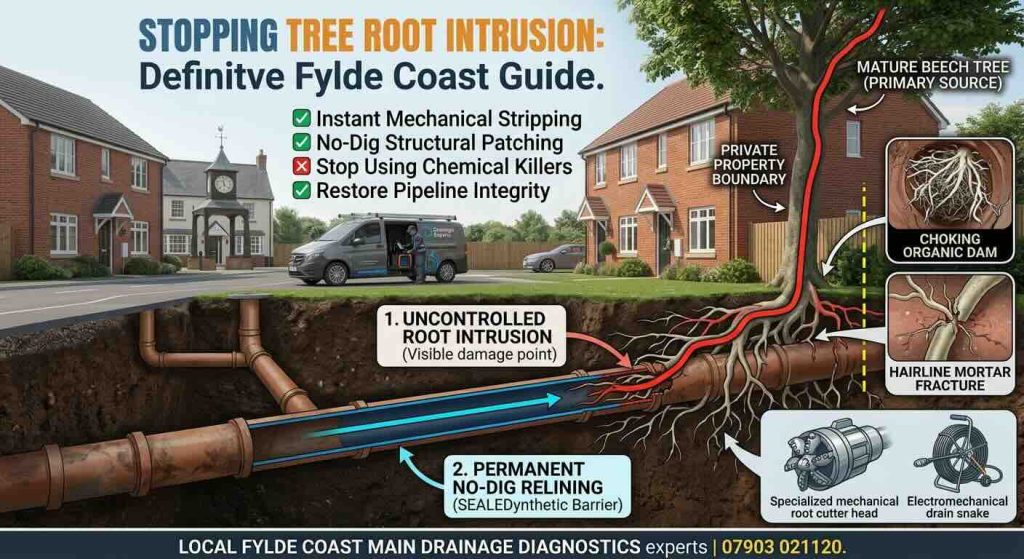
Tree roots do not actively “drill” through solid pipe walls. Instead, they act like moisture-seeking missiles. Sub-surface pipelines carry warm, nutrient-rich wastewater that constantly vents water vapour through tiny structural faults or failing mortar joints. Roots detect these microscopic vapour trails and expand directly toward the source, feeding through gaps as thin as a single piece of thread.
The Hidden Signs of Root Intrusion
Because your drainage lines are buried deep underground, a root system can thrive for months or years completely unnoticed. However, as the root mass expands, it acts as an underground dam, catching waste material and reducing internal flow velocity. Watch out for these primary warning signs:
- System-Wide Slow Drainage: Multiple sinks, baths, and appliances taking an unusually long time to empty simultaneously.
- Unexplained Structural Gurgling: Hearing a distinctive gurgling sound from your toilet when the shower drains, indicating compressed air bubbles trapped by an obstruction.
- External Displaced Surfaces: Paving slabs, garden brickwork, or tarmac driveways beginning to sink or split directly along the path of your drainage line.
- Saturated Garden Patches: Spots of lush, unusually green grass or damp patches forming during periods of dry weather where an outside gully or sub-surface line is leaking raw effluent into the surrounding soil.
Chemical Root Killer vs. Mechanical Cutting: The Reality
When faced with a slow-flowing system, many homeowners turn to chemical root killers available online or at local DIY shops. This approach is rarely effective and carries significant long-term drawbacks.
| Removal Parameters | Store-Bought Chemical Killers | Professional Mechanical Cutting |
|---|---|---|
| Immediate Clearance | Highly limited. Heavy structural root dams remain entirely intact, leaving blockages in place. | Instant. High-torque steel blades completely strip out dense root masses on contact. |
| Structural Impact | Corrosive chemical agents can rapidly deteriorate structural pipe linings and aged clay joints. | Completely safe. Precision-guided blades clear the interior wall without scraping structural components. |
| Environmental Risk | Severe. Dangerous toxins flow directly downstream into local water treatment facilities and rivers. | Zero chemicals utilized. Driven entirely by clean, hydraulic water pressure and mechanical torque. |
| Long-Term Prevention | None. Fails to repair the structural open crack, allowing the root to grow straight back within weeks. | Pairs perfectly with trenchless structural lining to permanently seal out future root paths. |
The Definitive Solution: Mechanical Stripping & Trenchless Lining
Resolving a root issue permanently requires a targeted, two-stage engineering approach. Attempting to clear roots with standard plunge rods will only tear small paths through the mass, resulting in a total structural blockage a few weeks down the line.
Stage 1: Precision High-Torque Mechanical Cutting
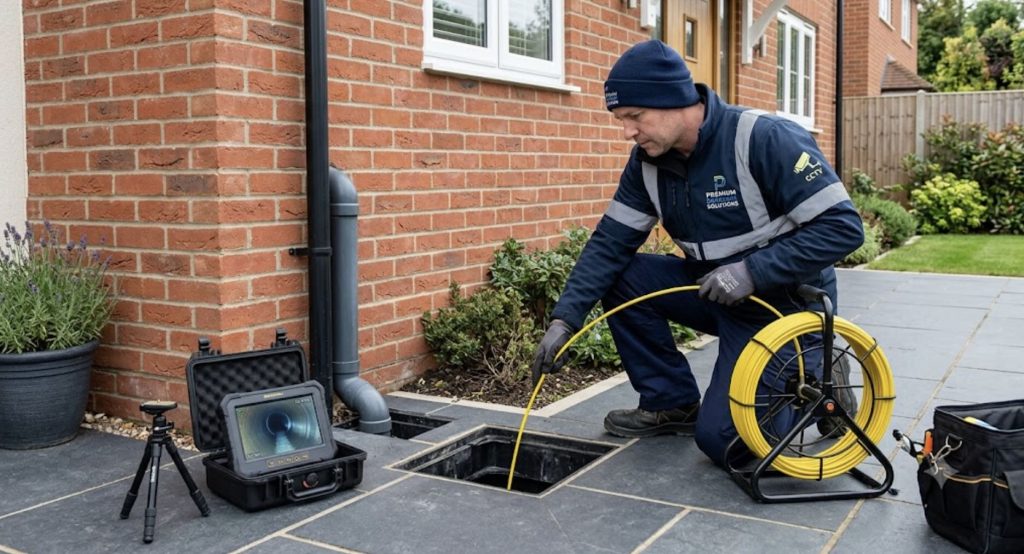
First, engineers deploy an advanced CCTV drain survey in Blackpool to locate the exact coordinate of the entry point. Once mapped, a specialized steel clearing head is launched down the line. Driven by high-pressure hydraulic water systems, these specialist cutters rotate at high speeds, safely cutting away dense root fibres and scabbing away organic grease scale until the original pipe diameter is completely restored.
Stage 2: Permanent No-Dig Structural Lining
Removing the root is only half the battle; if the crack remains open, the root will return. To solve this permanently without digging up your pristine garden or driveway, we utilize trenchless structural relining.
A flexible sleeve impregnated with advanced silicate resin is guided directly into the cleared pipe. Once positioned over the old fracture, an internal bladder is inflated, pressing the resin tight against the clay walls. As it cures, it creates a seamless, ultra-durable “pipe within a pipe”. This synthetic barrier features no joints or seams, making it impossible for future root systems to penetrate.
Understanding Blocked Drain Root Removal Costs
Every root infestation carries unique structural variables depending on the pipe depth, line diameter, and access points. However, professional root intrusion drainage repair in Blackpool remains highly cost-effective when compared to traditional dig-and-replace excavations:
- Standard Mechanical Root Cutting & Jetting Scour: Typically ranges between £250 and £400+ depending on layout complexity.
- No-Dig Structural Patch Repairs / Lining: Generally starts from £350, saving you thousands in surface reinstatement fees for driveways or lawns.
Before committing to any repair, it is critical to determine legal ownership of the run. As outlined in our guide to shared drain responsibility laws in the UK, if the root damage sits within a shared lateral line or extends past your boundary, the repair bill may fall directly to United Utilities rather than your household budget.
Stop the Penetration – Protect Your Home Assets Today
Do not let subterranean root networks quietly destroy your property’s foundations. At Drainage Experts, our mobile engineering teams carry professional-grade mechanical root cutters, robotic CCTV cameras, and trenchless structural relining systems to handle complex root infestations quickly and cleanly.
Talk Directly to a Root Clearance Specialist: 07903 021120
Fylde Coast Operations Base: 99 Breck Road, Poulton-le-Fylde, FY6 7AN
Book Your Camera Structural Diagnostics Check: Arrange a Precision Structural Pipe Assessment