
Water Leak on Pavement Outside My House: Who Is Responsible?
Discovering water pooling, streaming, or actively bubbling up through the tarmac of a pavement or garden path right outside your home can cause immediate anxiety. Most homeowners instantly panic about underground structural washouts, sinkholes, sinking foundations, or receiving an astronomical water bill from their supplier.
When you spot a water leak on the pavement outside your house, the immediate question is always one of legal and financial liability. Is the water board responsible for digging up the path, or are you looking at an expensive private repair bill? Across Blackpool and the wider Fylde Coast, establishing responsibility depends entirely on pinpointing the exact physical location of the pipe failure relative to your legal property line.
The Boundary Rule: Private vs. Public Infrastructure
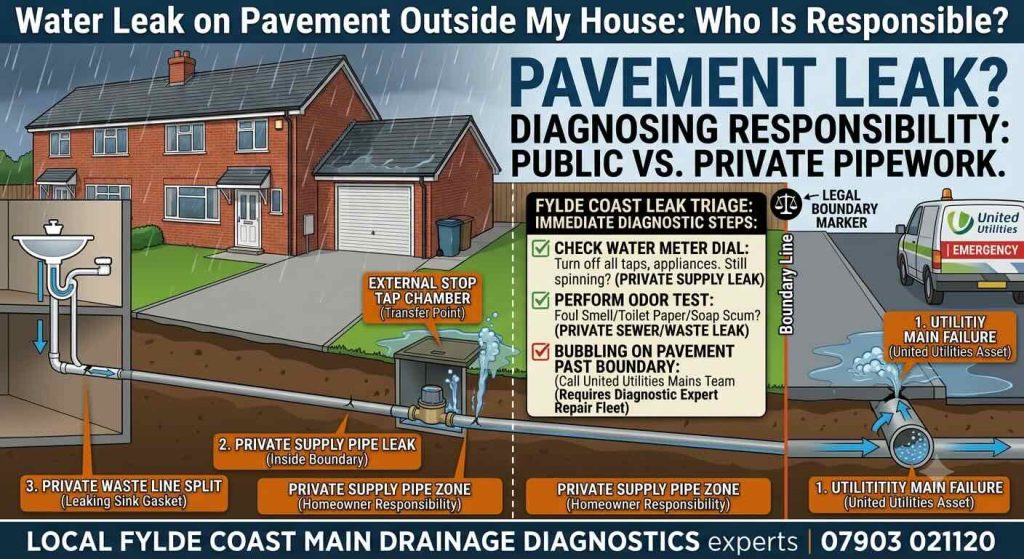
As a general legal rule across the UK, you are only responsible for the water pipes that lie within your private property boundaries. Any main distribution lines running under public highways or footpaths are the strict responsibility of your regional water utility company. Understanding this boundary is key before making emergency phone calls.
The Triage Phase: Is It Fresh Water or Sewage?
Before you can determine who to call, you need to identify what type of asset is actually leaking. Water escaping onto a pavement generally falls into one of three distinct categories:
1. Fresh Mains Clean Water (The Water Board Supply)
If the fluid is perfectly clear, completely odorless, and flows at a steady, uninterrupted rate regardless of whether your household appliances are running, it is highly likely to be a pressurized mains water leak. If you notice a United Utilities boundary leak—such as water pooling right around the external stop tap cover on the pavement—this is usually their asset to fix.
2. Domestic Waste Water (Private Drainage Fault)
If the water only appears intermittently—for example, pooling heavily right after someone empties a bathtub or runs a washing machine—you are likely looking at a broken greywater line, such as a **leaking waste pipe repair in Blackpool**. This water will often look slightly cloudy or contain traces of old soap scum.
3. Foul Sewage (Broken Sewer Laterals)
If the water pooling on the pavement or within your driveway has a distinct, foul odor, or if you can see debris like toilet tissue or organic matter escaping, an underground sewage line has collapsed or backed up. Refer to our emergency guide to blocked sewage manholes to determine if it’s a shared or private issue.
| Leak Location & Type | Legal Ownership | Who to Call / Financial Responsibility |
|---|---|---|
| Public Footpath / Street Mains Bubbling up through public tarmac past your boundary line. | Water Network Operator | United Utilities Emergency Line: They will execute all excavations and repairs at zero cost to you. |
| External Stop Tap Box Leaking from the meter chamber frame right on the pavement line. | Water Network Operator | United Utilities: This marker typically represents the exact point of ownership transfer. |
| Private Supply Pipe Between your external boundary marker and your internal internal stopcock. | Homeowner | The Property Owner: You are responsible for hiring private contractors to locate and repair the line. |
| Private Waste Line / Gullies Sink waste lines or structural driveway gullies leaking onto paths. | Homeowner | The Property Owner: Private drainage engineering contractors are required to repair the line. |
Two Immediate Steps to Test Your Property
Before calling out an engineer, you can perform a quick check to see if the leak belongs to your private supply line:
- Locate Your Water Meter: Turn off every single tap, shower, and appliance inside your house. Open your water meter chamber. If the dial or digital numeric indicator is still actively spinning, water is actively escaping somewhere down your private supply line.
- The Odor Test: If your meter is stationary but water is pooling on the path, drop a small amount of non-toxic food coloring down your kitchen sink. If that color shows up on the pavement ten minutes later, you have an isolated waste line split.
How Private Diagnostic Repair Fleets Resolve the Issue
If your testing indicates that the water leak is inside your boundary line, ignoring it can lead to severe structural damage. Escaping water quickly washes away the sub-base sand and soil beneath driveways and flagstones, causing paving to sink, crack, or wash away entirely—a symptom often linked to structural problems like failed driveway haunching or blocked ACO channels.
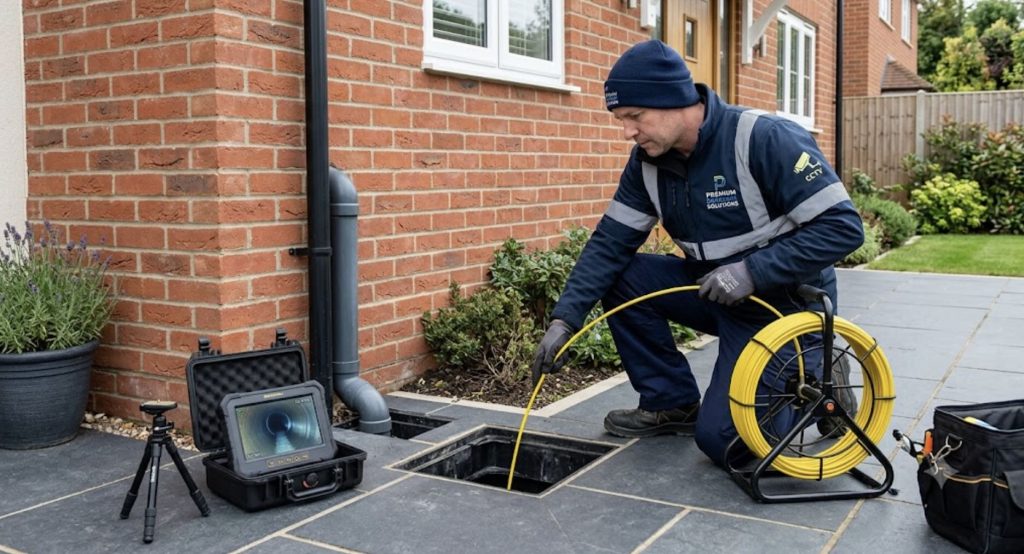
When you call an independent specialist team, we don’t just start blindly digging up your garden or driveway. We deploy advanced acoustic leak detection microphones and high-frequency structural trace equipment to map the exact underground path of your supply line and pinpoint the sound of escaping water. Once the leak is pinpointed to within a few inches, our engineering teams complete a clean, localized excavation to patch or replace the section, or deploy no-dig structural liners to resolve waste line splits with minimal disruption to your landscaping.
Is Water Leaking on Your Property? Take Action Now
If you have confirmed that the leak is on your side of the boundary line, do not let it compromise your home’s foundations or inflate your water bill. At Drainage Experts, we provide rapid-response leak detection, precision excavations, and expert pipe repairs for homeowners across the Fylde Coast.
Our experienced local engineering teams offer completely upfront, transparent pricing with no hidden emergency fees. Stop the leak before it causes major structural damage.
Speak to a Local Leak Diagnostic Specialist: 07903 021120
Fylde Coast Operations Base: 99 Breck Road, Poulton-le-Fylde, FY6 7AN
Book an Emergency Supply Line Assessment: Arrange a Diagnostic Pipe Survey & Precision Repair