
If you own an older Victorian terrace, an Edwardian semi, or a traditional property built before the 1950s across Blackpool or the Fylde Coast, your drainage network holds a hidden structural feature that modern homes don’t have: an interceptor trap (frequently referred to as a Bristol handle, sewer trap, or intercepting gully).
While these clay fittings were a marvel of public health engineering when they were introduced over a century ago, they have become one of the single most frequent causes of catastrophic mainline failure today. When an interceptor degrades, shifts, or plugs, it doesn’t just block a single toilet; it seals the entire property’s boundary output. Understanding how these traps operate—and analyzing a realistic **interceptor trap replacement cost**—is essential for resolving persistent, recurring drainage emergencies.
The Victorian Design Defect
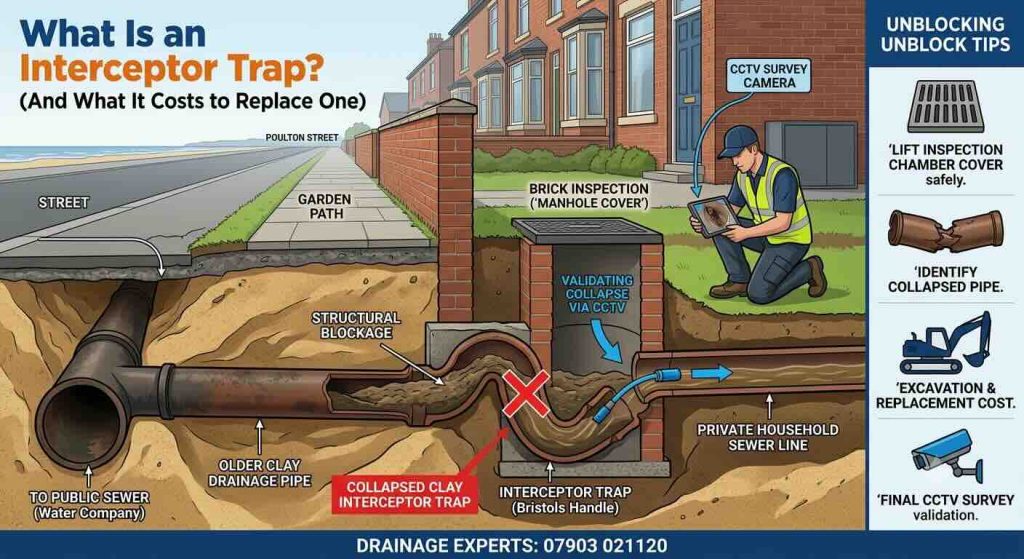
Interceptor traps are large, heavy clay U-bends installed underground precisely where your private sewer line crosses your property boundary to meet the public water company’s main road network. Their historical purpose was to maintain a continuous water pool to prevent foul smells and sewer rats from entering household lines. However, because they create a sharp, restrictive 90-degree physical barrier, they naturally catch passing toilet tissue, grease, and debris, rendering them a massive structural bottleneck.
The Signs of a Collapsed Boundary Interceptor
Because interceptors sit at the furthest point of your private boundary line, the symptoms of failure can trick homeowners into assuming they have a basic blockage nearby. If you notice these red flags, you are likely dealing with a structural boundary defect:
- Total Property Backups: Flushing any toilet or running any tap across the entire house simultaneously causes backups in ground-floor shower trays or low-lying garden gullies.
- The Unopenable Interceptor Plug: When you lift your brick inspection chamber cover in the garden, the chamber itself is completely dry, but the incoming pipe is fully charged and pressurized with stagnant waste.
- Sinking Paving Blocks: Shifting coastal sand sub-soils around the boundary inspection chamber cause concrete or paving flags above the trap area to drop or crack.
Breaking Down the Interceptor Trap Replacement Cost
If your mainline has suffered structural failure, calculating a realistic **interceptor trap replacement cost** requires reviewing the depth of the installation and the surface materials covering it. Because these clay traps are positioned near boundaries, they are frequently buried deep underground beneath driveways, heavy stone walls, or front garden pathways.
| Service Requirement | Average UK Cost Range | What It Covers |
|---|---|---|
| Diagnostic CCTV Survey | £90 – £180 | High-definition camera analysis to verify if the trap is blocked or structurally collapsed. |
| High-Pressure Jetting Clearance | £50 – £120 | Blasting through soft blockages trapped inside the U-bend to restore immediate flow. |
| No-Dig Structural Patch-Lining | £400 – £900 | Inserting a resin-impregnated glass sleeve through an existing opening to bridge minor cracks without digging. |
| Full Mechanical Excavation & Removal | £1,200 – £2,500+ | Digging out the collapsed clay trap completely, disposing of it, and rebuilding the run with modern, straight PVC pipework. |
How Much to Repair a Collapsed Drain?
When an interceptor breaks down completely, it often damages the surrounding lateral lines, leading homeowners to search for how much to repair a collapsed drain. A major pipe collapse requiring a deep open-cut excavation down to 1.5 or 2 metres can quickly reach £1,500 to £2,500+.
The total price depends on whether our engineers must cut through reinforced concrete driveways, dismantle boundary brickwork, or use mechanical shoring systems to secure shifting sand sub-soils common along our coastline. However, if the structural failure is caught early before a total collapse occurs, we can often bypass excavation entirely by using a no-dig ‘structural patch liner’ or executing a straight-pipe conversion via an existing inspection chamber opening.
The Critical First Step: CCTV Structural Validation
Do not allow anyone to start digging up your front garden or driveway based on guesswork. Because boundary drainage ownership lines can be highly complex under UK utility laws, investing in a definitive, professional drain survey cost (typically ranging between £90 and £180) is an absolute necessity.
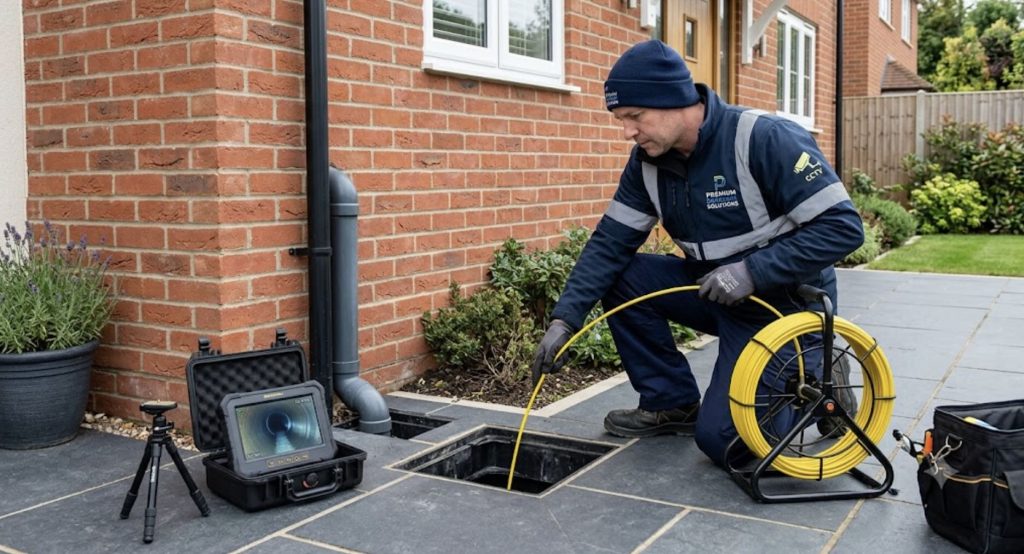
By deploying specialized pan-and-tilt robotic cameras down your lateral run, our drainage engineers can see the exact physical status of the interceptor. The camera will verify whether the line simply has a dropped clay joint, heavy root penetration, or a total structural collapse. This gives you concrete, visual proof before you commit to any major structural remediation budget.
Dealing with a Blocked or Broken Boundary Trap?
If your Victorian or Edwardian home is experiencing repeated, total property backups, an old clay interceptor trap is the highly likely culprit. At Drainage Experts, we specialize in high-intent structural diagnostics, no-dig patch-lining, and complex boundary excavations across Blackpool, Poulton-le-Fylde, and the wider Fylde Coast.
We provide fully fixed upfront pricing on all initial camera diagnostics, ensuring your drain unblocking in Blackpool includes a thorough, transparent evaluation of your boundary pipe integrity before any excavation work begins.
Consult with a Structural Drainage Specialist: 07903 021120
Local Diagnostic Hub: 99 Breck Road, Poulton-le-Fylde, FY6 7AN
Book a Boundary Camera Inspection: Arrange an Interceptor Trap Diagnostics Check