
Heavy seasonal downpours combined with the distinct geological makeup of the Fylde Coast can create absolute havoc for domestic properties. Whether you are dealing with a waterlogged lawn that resembles a marshland for six months of the year, or watching sheets of rainwater rush down your driveway toward your garage doors, pooling water is more than an annoyance—it threatens your property’s foundation integrity.
When searching for effective garden drainage solutions in Fylde, homeowners often run into technical terminology without clear guidance on what works best for their specific scenario. Implementing the wrong system can lead to wasted investment and worsen flooding. To protect your landscaping, you must understand how different systems handle surface water versus groundwater.
The Fylde Coast Challenge: Heavy Clay & High Water Tables
Large pockets of Blackpool, Poulton-le-Fylde, and Lytham St Annes sit on heavy, non-porous clay soils or feature exceptionally high coastal water tables. When heavy rainfall hits, the ground quickly becomes saturated, leaving nowhere for surface water to drain naturally. This results in common search queries like how to stop water pooling on lawn environments.
Breaking Down the Core Systems: How They Work Mechanically
Professional drainage engineering relies on selecting the right asset for the specific type of water problem your land is facing. Let’s examine the mechanical profiles of the three industry-standard solutions:
1. ACO Channel Drains (Surface Water Diversion)
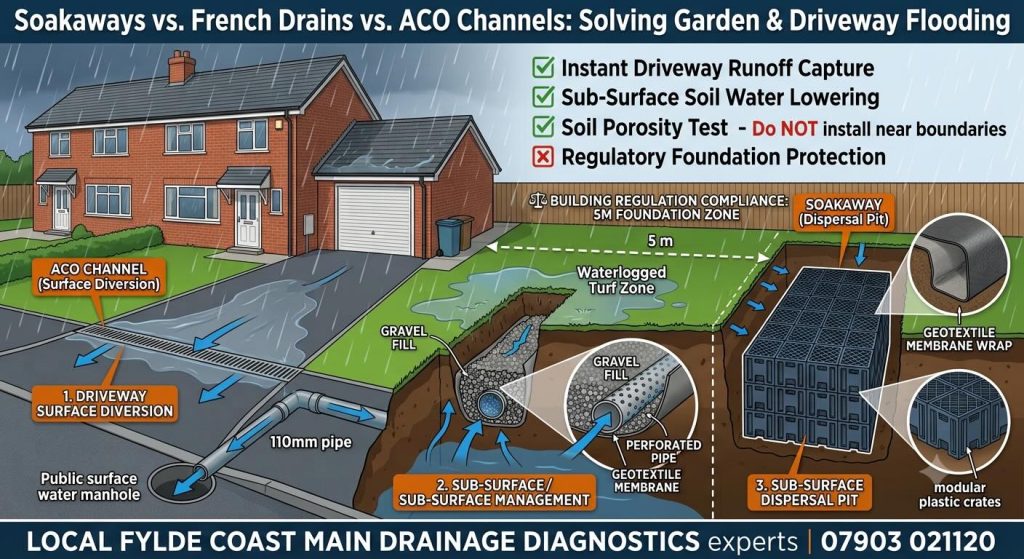
ACO channels (often referred to as slot or linear trench drains) are heavy-duty, grated plastic or concrete troughs installed flush into hard standings. You will frequently see systems like the driveway slot drains ACO Hexdrain variants running along the threshold of modern driveways, patio borders, or garage entries.
The Mechanics: They do not handle underground water. Instead, they act as an immediate surface barrier, catching fast-moving sheets of runoff water before it can flood a building or pool on tarmac. This captured water is then piped away rapidly into your property’s main surface water system.
2. French Drains (Sub-Surface Groundwater Management)
If your lawn remains soggy and squelches days after the rain has stopped, your issue isn’t surface runoff—it is a saturated, high sub-surface water table. A French drain is the direct mechanical solution for this problem.
The Mechanics: A trench is excavated into the affected ground, lined with a geotextile fabric, and fitted with a perforated plastic pipe. The trench is then filled back to the surface with clean, washed aggregate. Groundwater naturally seeks the path of least resistance, rising into the gravel matrix, trickling through the perforations into the pipe, and flowing safely away from your lawn area by gravity.
3. Soakaways (Sub-Surface Dispersal Pits)
A soakaway is a large, subterranean terminal point designed to collect large volumes of collected rainwater and slowly distribute it back into the surrounding earth without overloading public sewer networks. Modern systems use modular plastic matrix cells (known as soakaway crates) wrapped in a fine filtration membrane.
The Mechanics: Surface water caught by your house guttering downpipes or ACO channels is piped directly into this underground chamber. The crate structure acts as a temporary holding tank during peak downpours, giving the water time to slowly infiltrate back into the surrounding deep subsoil. Securing a professional soakaway installation in Blackpool requires careful pre-planning to make sure local soil conditions can actually handle the dispersal.
| Drainage Asset | Primary Problem Solved | Typical Installation Zone | Disposal Terminal Connection |
|---|---|---|---|
| ACO Channel Drain | Rapidly intercepts sheets of fast-flowing surface water. | Driveways, garage thresholds, patio perimeters. | Connected via silt traps straight into surface water mains or soakaways. |
| French Drain | Lowers saturated groundwater levels underneath lawns. | Waterlogged turf zones, garden perimeters, slopes. | Routed to lower-level terrain, outfalls, or main storm networks. |
| Soakaway Crate System | Provides high-capacity underground retention and natural ground infiltration. | Must sit at least 5m away from home foundations. | Acts as the final eco-friendly terminal point for clean rainwater run-off. |
Why Proper Engineering Rules Matter (Part H Compliance)
You cannot simply dig a hole, drop a pipe, and hope for the best. Under UK Building Regulations, soakaways are legally restricted. They cannot be installed within 5 metres of a building foundation or near property lines where they could cause structural shifting or damp issues on a hill. Furthermore, if your soil has a high clay content, a mandatory percolation test must be performed by a qualified engineer to calculate the soil’s exact water absorption rate before any installation can begin.
Why You Need Full-Scale Drainage Engineers
Many general landscaping firms offer to throw a French drain into your lawn, but without precise hydraulic calculations, these systems frequently fail within a single winter season. If a trench is dug with an incorrect gradient, or if standard gravel is used without proper geotextile membranes, the pipe will silt up, clog with clay particles, and stop working entirely.
As comprehensive drainage engineering specialists, our teams handle the entire process technically. From executing initial soil percolation tests and Calculating rainfall run-off catchments, to deploying heavy excavation plant equipment for deep soakaway installations, we ensure your infrastructure is built to last. We don’t just clear surface water; we protect your foundations, add long-term structural value to your property, and ensure your garden remains functional all year round.
Stop the Squish – Restore Your Property’s Landscaping
Don’t let a waterlogged garden ruin your outdoor space or pool against your driveway. At Drainage Experts, we design, calculate, and install fully compliant, long-lasting surface and sub-surface drainage systems tailored strictly to the unique soil conditions of the Fylde Coast.
Our experienced engineering teams provide completely transparent, upfront pricing on all minor and major civil installations. Secure your home’s structural safety today.
Call Our Civil Drainage Engineering Team: 07903 021120
Technical Site Operations Base: 99 Breck Road, Poulton-le-Fylde, FY6 7AN
Request a Ground Health Assessment: Book an Expert Site Survey & Soil Porosity Consultation